
If you sell ACA coverage, there is one 2026 mistake you cannot afford to make: assuming low-income consumers still have a year-round doorway into Marketplace coverage. They do not. CMS ended the monthly SEP for APTC-eligible consumers at or below 150% of the federal poverty level effective August 25, 2025, and it remains unavailable through the end of plan year 2026. CMS also clarified that income alone is not an “exceptional circumstance” Exchanges can use to create a substitute income-based SEP.
For agents, the real issue is not just what disappeared. It is what replaces it in your day-to-day workflow. In 2026, the agencies that stay sharp are the ones that can answer four questions quickly and confidently: Can this client still enroll? Which SEP, if any, actually fits? What documents do we need before we promise anything? And can we prove our process later if CMS asks?
What Changed, Exactly?
Before this change, the 150% FPL SEP gave certain APTC-eligible consumers a monthly opportunity to enroll in or change Marketplace plans based solely on low income. That pathway ended August 25, 2025, and the 2025 Marketplace Integrity and Affordability Final Rule paused it through the end of plan year 2026 for all Exchanges.
The next update is now final too. CMS finalized in the 2027 Payment Notice final rule that Exchanges remain prohibited from offering the 150% FPL SEP after plan year 2026. Agents should not build a 2027 sales calendar, lead campaign, or low-income prospect workflow around this SEP coming back.
The 150% FPL SEP is only one part of the rule. The companion 2027 ACA Marketplace final rule checklist for agents covers the related marketing, verification, training, consent-record, and APTC reconciliation changes in one practical workflow.
What did not change is just as important. Other SEP pathways still exist. Consumers may still enroll mid-year if they qualify through a standard SEP or certain complex SEP circumstances, such as loss of minimum essential coverage, marriage, birth or adoption, certain moves, release from incarceration, Medicaid/CHIP timing issues, domestic abuse or spousal abandonment, disasters, misconduct or display errors, or a successful appeal. Tribal consumers and ANCSA shareholders also still have a monthly SEP. For the broader scenario-by-scenario screen, use the 2026 ACA SEP field guide for health insurance agents.
One more correction matters here: for 2026 coverage, the federal Open Enrollment Period was still November 1 through January 15. The shorter OEP does not start until plan year 2027.
Why CMS Pulled the Plug
CMS tied the change to program-integrity concerns. In the final rule, the agency pointed to improper enrollments, unauthorized plan switching, and risk-pool concerns, and said the 150% FPL SEP had been exploited in ways that harmed consumers and distorted enrollment behavior.
That means this is not just an eligibility change. It is part of a broader compliance environment in which CMS is paying closer attention to how enrollments happen, who initiated them, and whether the agent can prove the consumer actually authorized the help they received. CMS also codified a “preponderance of the evidence” standard for terminations for cause of Marketplace agent, broker, and web-broker agreements.
What Agents Actually Need to Understand in Practice
The first practical takeaway is simple: income is no longer the event. If a prospect says, “I’m under 150% FPL,” that statement alone no longer opens a Marketplace enrollment window. Your next job is to screen for another SEP or for Medicaid/CHIP eligibility, which remains available year-round.
The second takeaway is that loss of minimum essential coverage is now even more important. CMS’s 2026 SEP materials say consumers generally can report a future loss up to 60 days before it happens and usually have 60 days after the loss to pick a plan. For Medicaid or CHIP loss, Exchanges may allow up to 90 days after the loss. Loss of employer coverage, most Medicaid/CHIP coverage, Medicare Part A or Medicare Advantage, aging off a parent’s plan, and discontinued individual or group coverage can qualify; short-term limited-duration insurance does not.
The third takeaway is that agents should be careful about timing. For 2026, the broader federal-platform SEP verification policy from the 2025 final rule was stayed, while loss-of-MEC verification continued. But CMS has now re-finalized the broader policy for 2027. Beginning January 1, 2027, Exchanges on the federal platform must conduct pre-enrollment verification for enough new SEP enrollments to equal at least 75 percent of prior-year SEP enrollments.
The smart operating posture is to treat more SEP cases as document-first. Even when a category is not verified in the exact same way everywhere, your agency should be ready to prove the event before promising an effective date.
What to Do When a Low-Income Prospect Calls You Mid-Year
Start with a tighter screening flow.
First, check whether the client may qualify for Medicaid or CHIP. Those programs can be applied for any time of year, and that is often the right lane for households on the lower end of the income scale.
Second, screen for a real SEP, not a hoped-for one. The highest-value questions are usually these: Did you lose coverage? Did you get married? Have a baby, adopt, or receive a court order? Move to a new service area? Get released from incarceration? Receive a Medicaid or CHIP denial after Open Enrollment or after another SEP window closed? Experience agent misconduct, a display error, a disaster, or domestic abuse/spousal abandonment?
Third, collect documents before you promise an effective date. On the federal platform, verified SEP cases may be pended until SEP verification is resolved, and consumers generally have 30 days after plan selection to submit required documents. For 2027, agents should expect more federal-platform SEP files to need that same document discipline.
Fourth, if there is no SEP, say so clearly and professionally. A good agent conversation in 2026 sounds like this:
“Low income by itself no longer creates a special enrollment right. What I need to determine next is whether you’ve had a qualifying event that still allows enrollment now. If not, I’ll help you prepare early for the next Open Enrollment so nothing gets missed.”
That answer builds trust because it is accurate, specific, and useful.
The SEP Pathways Agents Should Have at Their Fingertips
Marriage still works, but it is not automatic. CMS says one spouse generally must have had qualifying health coverage for at least one day in the 60 days before the marriage, subject to exceptions such as certain tribal status, prior residence in a foreign country or U.S. territory, or living in an area where no Marketplace QHP was available.
Permanent moves still work, but they also usually require prior qualifying coverage in the 60 days before the move, again with exceptions for consumers moving from abroad or a U.S. territory, certain tribal consumers, or those coming from an area where no Marketplace QHP was available. Moving for medical treatment or vacation does not count.
Consumers who were stuck in the non-expansion Medicaid gap and then become newly eligible for premium tax credits because of an income increase or a move may qualify for a SEP. Consumers who applied for Marketplace or Medicaid/CHIP coverage during Open Enrollment or another SEP and were later found ineligible for Medicaid/CHIP after that window closed may also qualify.
And no, the 150% FPL SEP change did not wipe out the monthly SEP for Tribal consumers. CMS specifically said the pause does not affect the monthly SEP for members of federally recognized Tribes under 45 C.F.R. § 155.420(d)(8).
Your Compliance Process Matters More Than Your Memory
For ACA agents, the biggest post-150% FPL SEP mistake is sloppy documentation. CMS requires agents and brokers to document consumer consent before providing enrollment assistance or facilitating enrollment. CMS also requires agents and brokers to document that the consumer reviewed and confirmed the accuracy of eligibility application information before submission. Both sets of records must be maintained for at least 10 years and produced to CMS upon request in connection with audit, monitoring, or enforcement actions.
That timing rule matters after the first enrollment too. CMS says the same documentation standard generally applies when an agent later makes changes or updates to the eligibility application on the consumer’s behalf.
CMS does not require one specific documentation format, but it does say the consumer or authorized representative must take an action that produces the record. Acceptable examples include a signed document, verbal confirmation captured in an audio recording, or a written response to the agent’s communication. CMS’s model materials also include verbal scripts and say recorded calls may be used where state law allows.
There is another detail many agents miss: consent documentation and Marketplace Call Center authorization are not the same thing. If you are working with the Call Center on a consumer’s behalf without the consumer on the line, CMS says you need both the underlying consent/application-review documentation and separate Call Center authorization. That authorization must be renewed every 365 days. And if the issue is an NPN change on an FFM enrollment, CMS says the consumer must be directly involved, either through a three-way call with the Marketplace Call Center or through an approved EDE consumer pathway or HealthCare.gov.
This is why the right compliance question is not, “Did we save a file somewhere?” It is, “Can we retrieve the exact record, show the consumer’s action, show the timing, and prove what we reviewed before submission?” For agencies and broker networks that need that discipline across a downline, the ACA consent platform for agencies gives agents personal consent links, QR codes, 10-year record storage, and retrievable audit history without replacing the enrollment workflow.
For a direct answer from CMS on whether the 150% FPL SEP is still available, see the official CMS Agent/Broker FAQ on the 150% SEP.
Carry the case forward without rebuilding it
Move from SEP research to plan comparison with the client record intact.
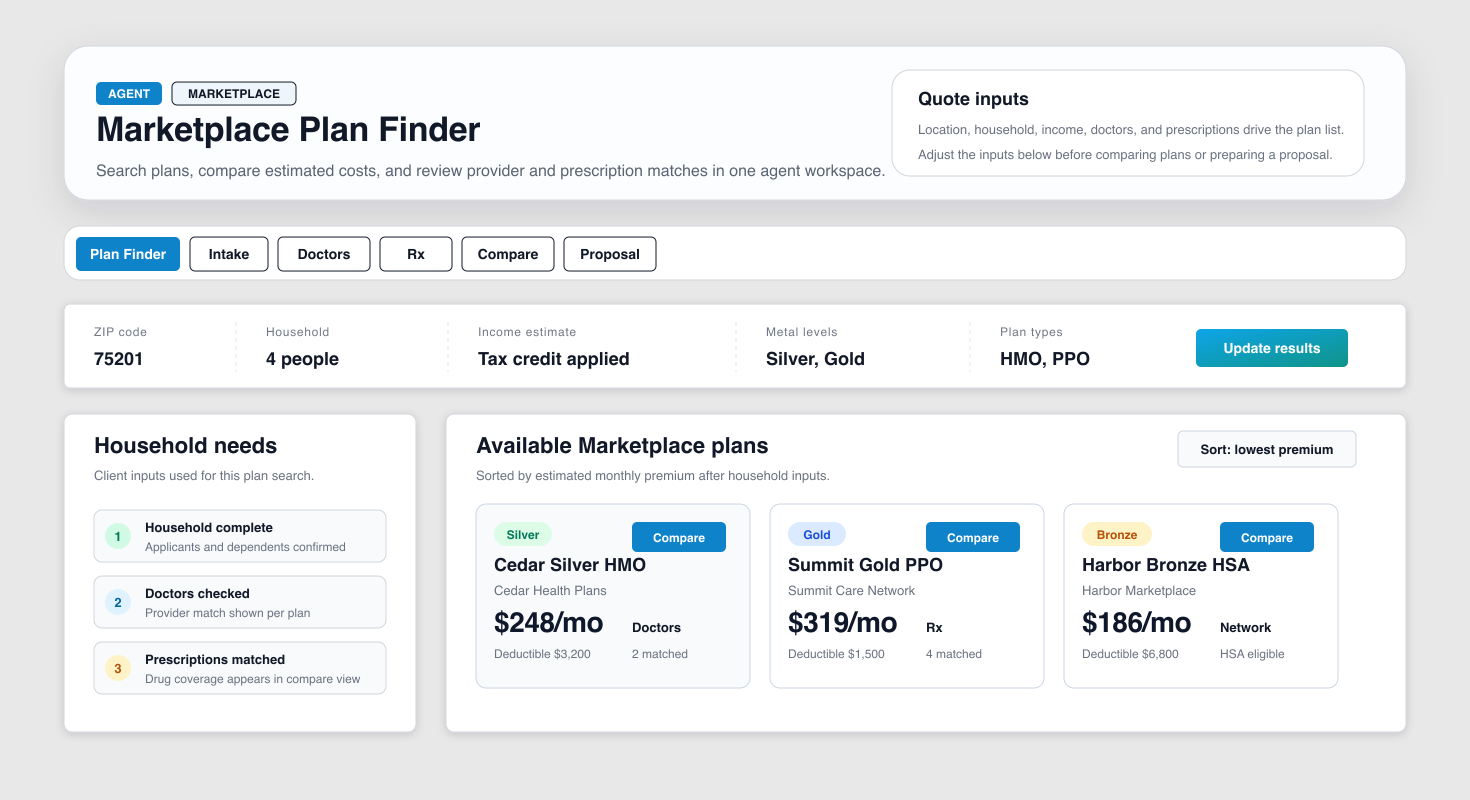
Agent Workspace connects the client record to Marketplace Plan Finder, ACA consent and application-review records, documents, notes, and follow-up so the next step does not start in a different system with no context.
Essentials is available through a guided demo. It has no public price, free trial, or automatic production signup.
What This Means for Your Book of Business
For many agencies, this change shrinks one of the cleanest year-round conversion paths. More mid-year low-income leads will now end in one of three places: Medicaid/CHIP, a standard SEP, or an Open Enrollment follow-up queue. That is not a disaster. It just means your edge in 2026 is no longer speed alone. It is triage, precision, and follow-through.
The agencies that will feel the least pain are the ones that can quickly separate “not eligible today” from “eligible with the right SEP,” document every interaction cleanly, and re-market no-SEP prospects when OEP arrives.
What 2027 Changes Now
The 2025 final rule originally said the 150% FPL SEP pause would sunset after plan year 2026. CMS has now finalized a different answer: Exchanges remain prohibited from offering the 150% FPL SEP after PY 2026.
That matters because it turns a temporary-looking pause into the working rule for 2027 planning. Low income by itself is still not the event. Agents need to screen for a real SEP, Medicaid or CHIP eligibility, or the next Open Enrollment window.
The second 2027 change is verification. Federal-platform Exchanges must verify at least 75 percent of new SEP enrollments before enrollment. That does not mean every state-based Exchange will feel identical in practice, but it does mean HealthCare.gov workflows need earlier document collection, clearer client expectations, and tighter follow-up.
Bottom Line
The end of the 150% FPL SEP is not just a policy update. It is a workflow change. The agents who win in this environment will be the ones who know which SEPs are still alive, explain the rules without confusing clients, and keep records that stand up if CMS ever asks for them.
That is the new value proposition in ACA sales: not just helping people enroll, but helping them get into the right lane, at the right time, with a process you can defend.
This article is for educational purposes only and is not legal or tax advice. Agents should also confirm current CMS guidance, state-exchange rules, and carrier procedures before relying on any single enrollment pathway.
Sources
- HHS Notice of Benefit and Payment Parameters for 2027 Final Rule: Centers for Medicare & Medicaid Services Accessed 2026-05-30.
- Federal Register: HHS Notice of Benefit and Payment Parameters for 2027: Federal Register Accessed 2026-05-30.
- 2025 Marketplace Integrity and Affordability Final Rule: Centers for Medicare & Medicaid Services Accessed 2026-05-30.
Frequently Asked Questions
Is the 150% FPL SEP still available in 2026?
No. CMS ended it on August 25, 2025, and it remains unavailable through the end of plan year 2026.
Does the elimination apply only to HealthCare.gov states?
No. The pause applies to all Exchanges through PY 2026. CMS also said low income is not an exceptional circumstance Exchanges can use to create an income-based SEP under that authority.
Can a client under 150% FPL still get Marketplace coverage mid-year?
Yes, but not because of income alone. They still need another valid SEP or they may need to pursue Medicaid/CHIP, which remains available year-round.
Which SEP is actually being pre-verified right now on the federal platform?
For 2026, federal-platform Exchanges continued pre-enrollment verification for loss-of-MEC SEPs while the broader 2025 policy was stayed. CMS has now finalized a 2027 rule requiring federal-platform Exchanges to verify at least 75% of new SEP enrollments before enrollment.
Does this change affect the monthly SEP for Tribal consumers?
No. CMS said the pause on the 150% FPL SEP does not affect the monthly SEP for members of federally recognized Tribes.
How long do I need to keep Marketplace consent and application-review records?
At least 10 years, and you must provide them to CMS upon request in connection with audit, monitoring, or enforcement actions.
What counts as acceptable documentation?
CMS says acceptable methods can include a signed document, verbal confirmation captured in an audio recording, a written response from the consumer, or other similar documentation specified in HHS guidance.
Can I speak with the Marketplace Call Center for the client if I already have consent on file?
Not by itself. CMS says Call Center authorization is separate from consent and application-review documentation, and that Call Center authorization must be renewed every 365 days.
What if the Marketplace says the client does not qualify for an SEP?
The consumer can appeal. HealthCare.gov says that if the Marketplace denies an SEP request and the appeal succeeds, coverage can be restored back to the date the SEP was denied.
Will the 150% FPL SEP return in 2027?
No. CMS finalized continuing the prohibition after plan year 2026, so Exchanges remain prohibited from offering the 150% FPL SEP in 2027 and beyond unless future policy changes.
Medicare and ACA Compliance Expert
Christian Rodgers is a Medicare and ACA compliance expert with over 30 years in the healthcare industry, having worked for some of the largest health plans in the United States. He has provided Medicare sales training to hundreds of agents in California and Florida.
Connect on LinkedIn